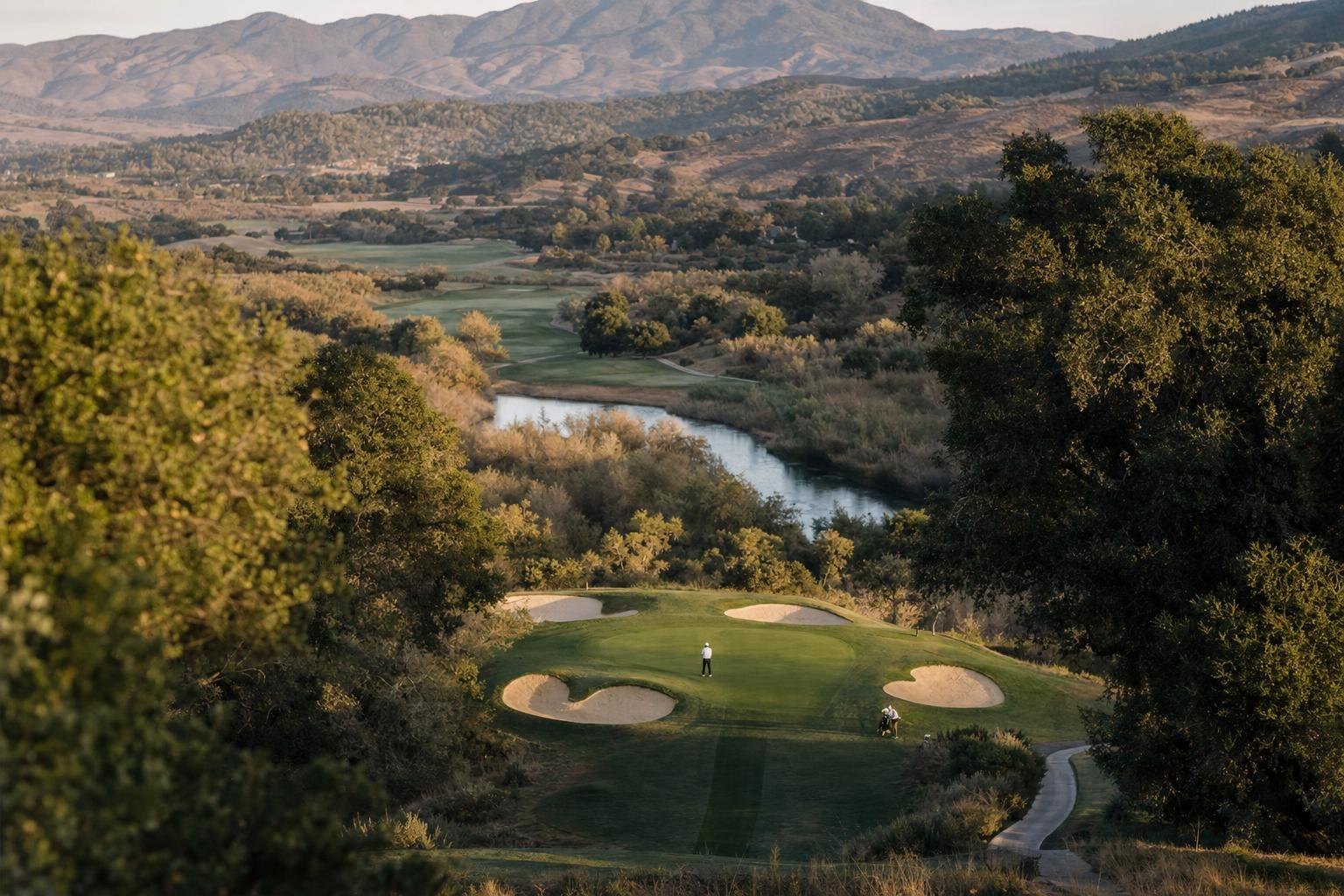
The original card at Rancho San Marcos names every hole, and most of the names point to something on the land: a vineyard, a river, a corral, a stable, a stagecoach road. Reading them in order is a fair way to understand the property before the first tee shot.
How the course is laid out
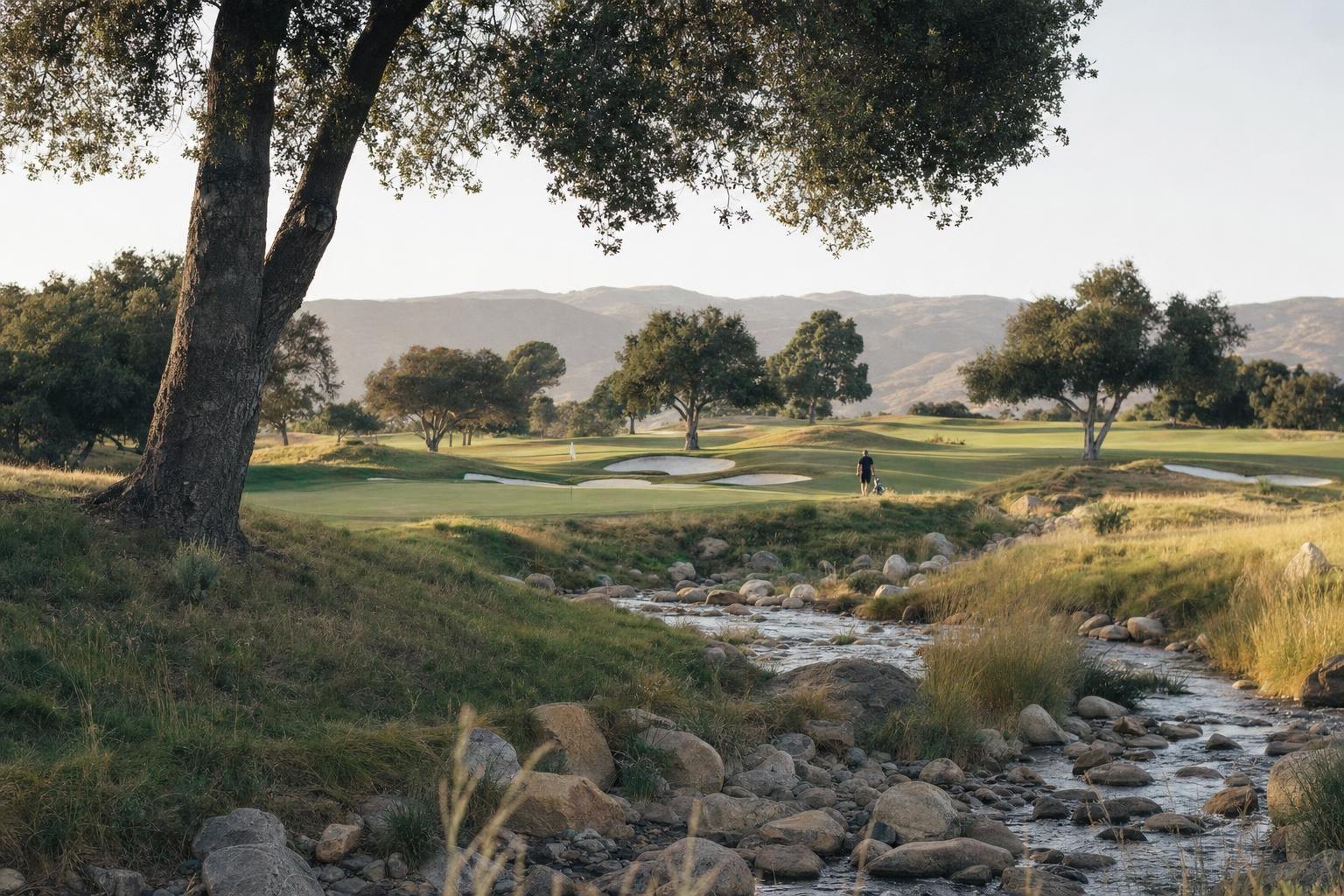
Robert Trent Jones Jr. routed the course across roughly 300 acres off Highway 154, between Santa Barbara and the Santa Ynez Valley. His firm describes three distinct zones, starting on the valley floor and finishing on a ridge that looks over Lake Cachuma. On the way the holes pass 19th-century adobe buildings, groves of very old oaks and the line of the stagecoach trail that once crossed the ranch.
The course opened in January 1998 and went through a renovation in 2007. It closed in 2020, and in April 2025 it reopened with nine holes in play. The nine-hole card the course uses now measures 3,501 yards at par 35, and those totals match the original front nine from the black tees exactly. The back nine, holes 10 to 18, is described here as it appeared on the original scorecard.
Every hole below lists:
- par
- yardage from the black, white and green tees
- the men’s handicap rank, where 1 is the hardest hole and 18 the easiest
The full card, with totals and tee-by-tee figures, is on the Rancho San Marcos scorecard page, and the background of each name is easier to follow after reading the history of the ranch.
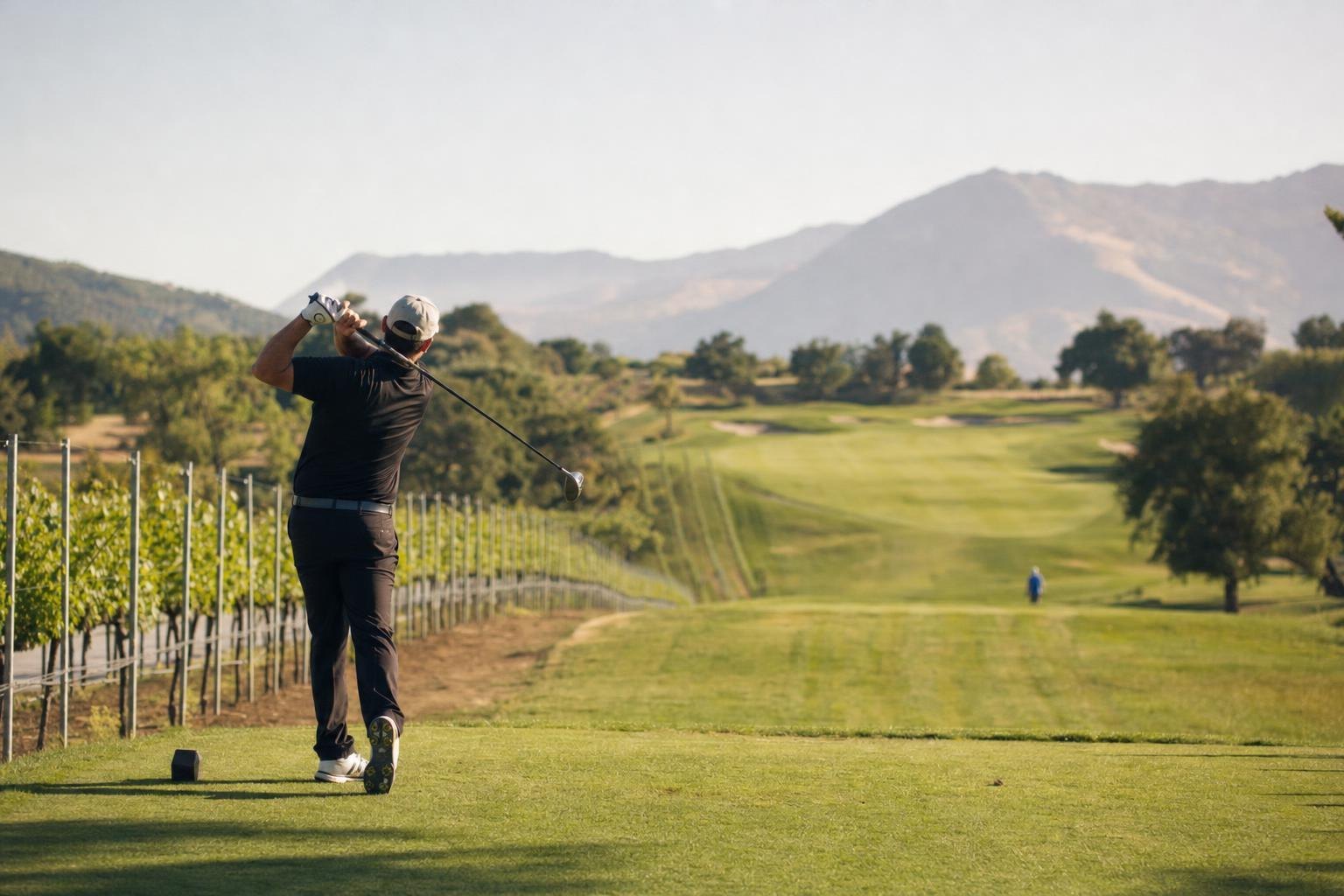
Holes 1 to 3: Vineyard, Paradise and River Run
Hole 1, Vineyard (par 5)
Black 635, white 560, green 481. Handicap 11. The round opens with the longest hole on the card. At 635 yards from the back it is a genuine three-shot par 5 for almost every player, and the first decision is not how far to hit the driver but where to leave the second shot for a comfortable wedge.
Hole 2, Paradise (par 3)
Black 202, white 172, green 113. Handicap 15. After the long opener the course turns straight to a par 3. Over 200 yards from the black tees it asks for a long iron or hybrid; from the green tees it becomes a short iron, the widest spread between tees anywhere on the front nine.
Hole 3, River Run (par 4)
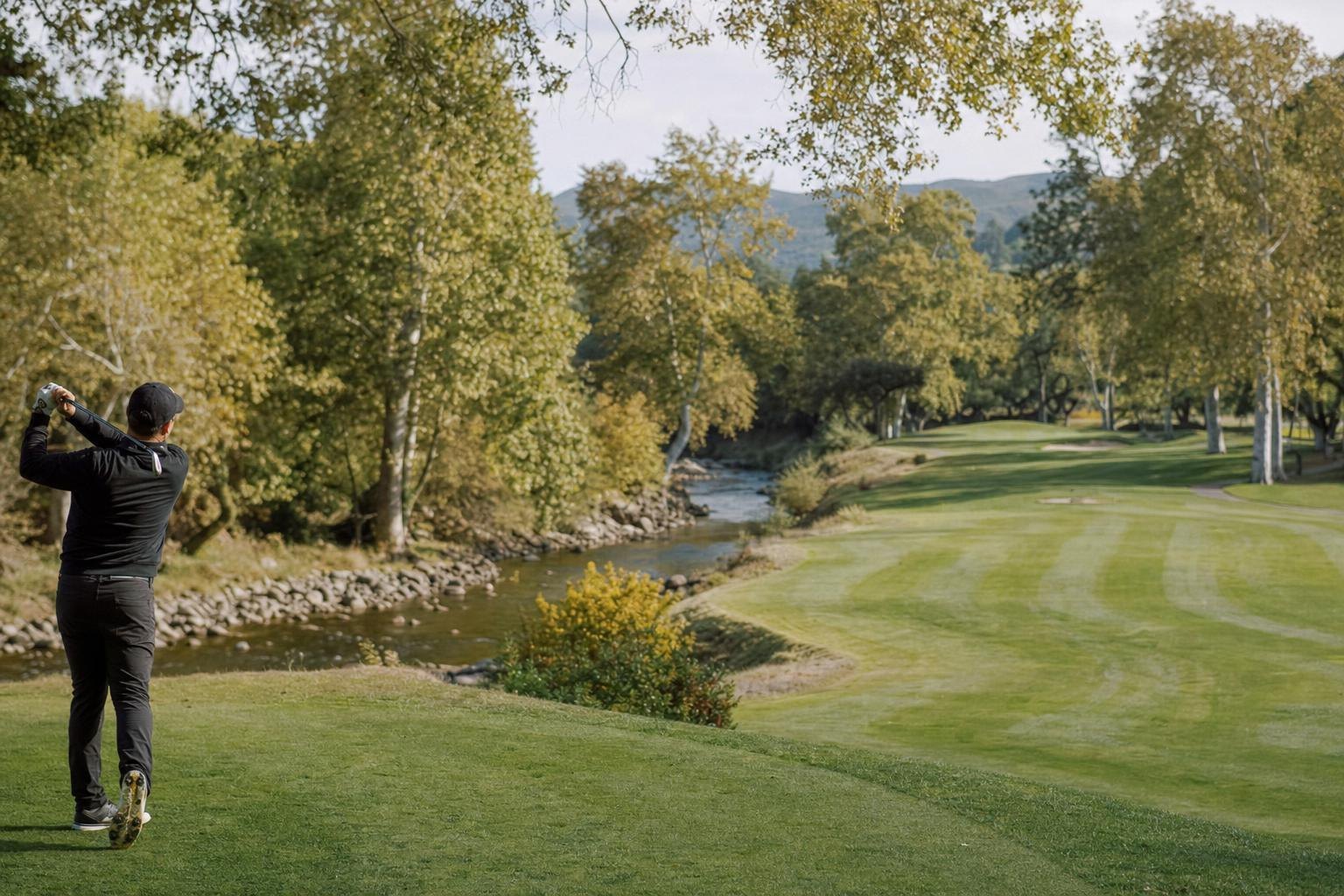
Black 379, white 314, green 255. Handicap 3. Short by the numbers, yet ranked the third-hardest hole on the course. A par 4 under 380 yards that carries a handicap of 3 usually means accuracy matters more than length, and the name suggests the line of play follows the river corridor.
Holes 4 to 6: Corral, Figueroa and Long View
Hole 4, Corral (par 4)
Black 421, white 379, green 299. Handicap 7. A full-length par 4 from the back. The name goes back to the ranch years, when horses and cattle shared this ground long before any fairway was cut.
Hole 5, Figueroa (par 3)
Black 202, white 166, green 164. Handicap 13. The second 202-yard par 3 of the front nine. The white and green tees sit only two yards apart, so for many groups this hole plays almost the same length for everyone.
Hole 6, Long View (par 5)
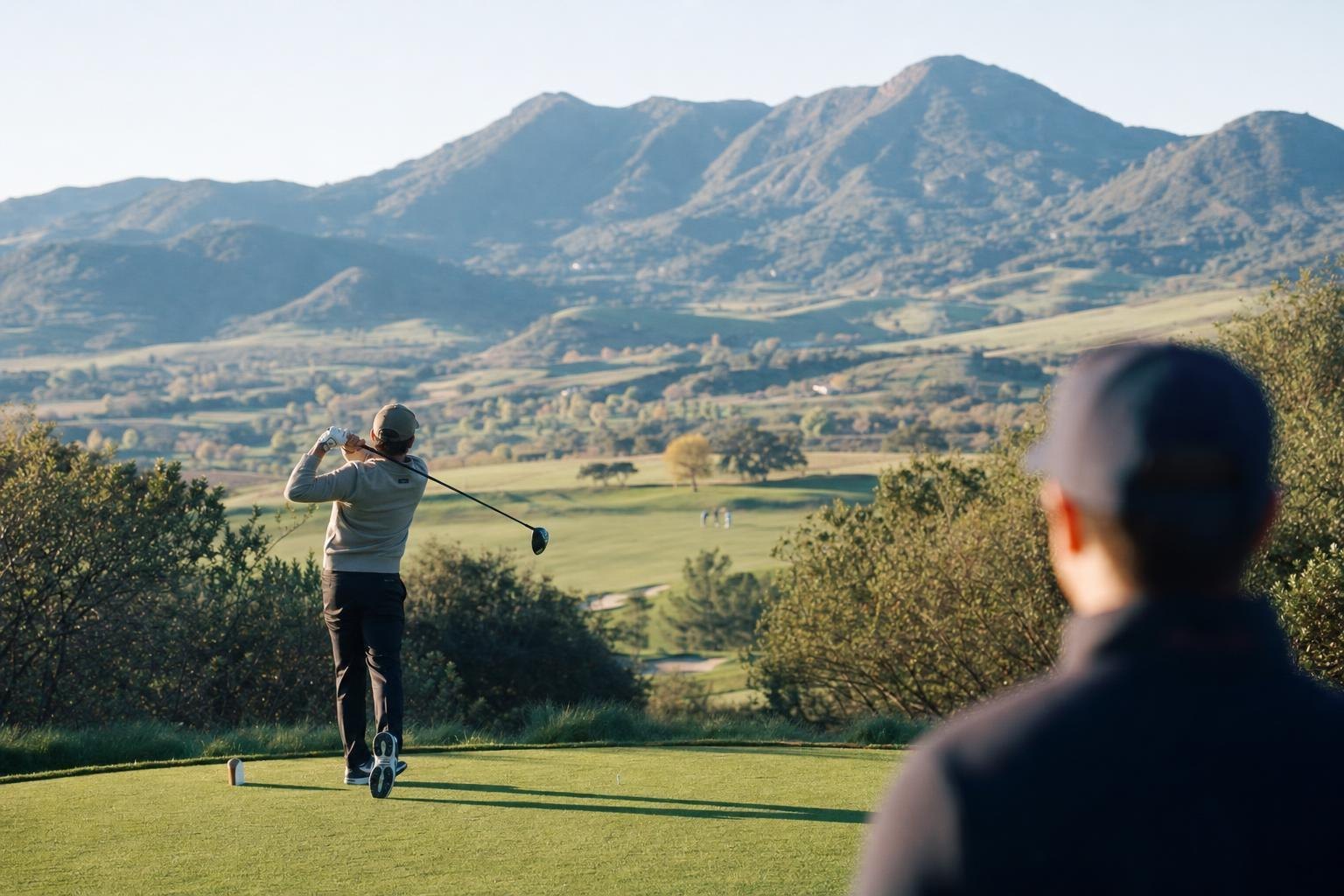
Black 629, white 585, green 514. Handicap 1. The hardest hole on the card by the handicap ranking, and only six yards shorter than Vineyard. Even from the green tees it measures over 500 yards. The name describes what the hole offers: an open view down the valley.
Holes 7 to 9: Ranchero, Twin Oaks and Davy Stables
Hole 7, Ranchero (par 3)
Black 179, white 165, green 144. Handicap 17. The shortest of the front-nine par 3s and the second-easiest hole by ranking. It is the clearest birdie chance before the turn.
Hole 8, Twin Oaks (par 4)
Black 434, white 388, green 368. Handicap 5. A long par 4 named after a pair of oaks, the tree that defines this whole property. At 434 yards from the black tees it is one of the stiffer two-shot holes on the course.
Hole 9, Davy Stables (par 4)
Black 420, white 387, green 328. Handicap 9. The front nine closes with another solid par 4. The name recalls the stables, and for years the course’s cafe carried a similar name, Davy’s Stable Cafe, which is no longer operating.
Front-nine totals: par 35, black 3,501, white 3,116, green 2,666. Since April 2025 these nine holes are the round: a nine-hole card of 3,501 yards, or the same nine played twice for 18. Current prices for both options are on the green fees page.
Holes 10 to 12: Hot Springs, Old Headquarters and Santa Ynez
Hole 10, Hot Springs (par 5)
Black 491, white 473, green 394. Handicap 4. The back nine starts with the shortest par 5 on the card, under 500 yards from every tee. A handicap of 4 suggests it defends itself in ways the yardage does not show.
Hole 11, Old Headquarters (par 4)
Black 447, white 422, green 309. Handicap 6. The longest par 4 on the course. The name refers to the old ranch headquarters, one of several reminders on the card that the land was a working ranch for well over a century before golf arrived.
Hole 12, Santa Ynez (par 5)
Black 528, white 503, green 460. Handicap 10. Named for the valley and the river that runs through it. A mid-length par 5 that gives longer hitters a chance to reach in two from the white tees.
Holes 13 to 15: Mesa, Eagle’s Nest and Bear’s Back
Hole 13, Mesa (par 3)
Black 139, white 118, green 118. Handicap 18. The shortest hole on the course and the easiest by ranking. As the name says, it plays on the mesa, the higher ground of the routing.
Hole 14, Eagle’s Nest (par 3)
Black 175, white 157, green 149. Handicap 16. A second short hole straight after Mesa. Back-to-back par 3s are unusual on any card, and here they sit in the climb toward the ridge.
Hole 15, Bear’s Back (par 4)
Black 443, white 390, green 353. Handicap 2. The second-hardest hole on the course, a long par 4 with a name that suggests a humped landform. A bear also appeared in the course’s own logo for many years.
Holes 16 to 18: San Fernando, Stagecoach and Los Padres
Hole 16, San Fernando (par 3)
Black 223, white 199, green 145. Handicap 14. The longest par 3 on the card at 223 yards from the black tees, with a 78-yard gap to the green tees.
Hole 17, Stagecoach (par 4)
Black 450, white 382, green 360. Handicap 12. Named for the stagecoach road that crossed the ranch. The Santa Ynez Turnpike, a toll road built in 1868 and in service from 1869 to 1901, carried six-horse stages over the mountains on this route.
Hole 18, Los Padres (par 5)
Black 542, white 518, green 432. Handicap 8. The round ends with a par 5 that shares its name with the Los Padres mountains on the northern horizon. Back-nine totals: par 36, black 3,438, white 3,162, green 2,720.
Patterns across the 18 holes
Set side by side, the numbers on the card show how the course was put together. The six par 3s cover a wide range, from Mesa at 139 yards to San Fernando at 223, so a full round asks for almost every club in the bag on the short holes alone. Three of them, Paradise, Figueroa and San Fernando, are over 200 yards from the black tees, while Ranchero, Mesa and Eagle’s Nest sit between 139 and 179.
The par 5s split into two groups. Vineyard and Long View, both on the front nine, are over 625 yards from the back and play as true three-shot holes. Hot Springs, Santa Ynez and Los Padres on the back nine run from 491 to 542 yards, which is where stronger players can think about reaching a green in two.
| Group | Holes | Black yards |
|---|---|---|
| Long par 5s | 1, 6 | 629 to 635 |
| Shorter par 5s | 10, 12, 18 | 491 to 542 |
| Long par 3s | 2, 5, 16 | 202 to 223 |
| Short par 3s | 7, 13, 14 | 139 to 179 |
The handicap ranking points at the par 4s and the long par 5s as the real test. Of the five hardest holes by rank, three are par 4s (Bear’s Back, River Run and Twin Oaks) and two are par 5s (Long View and Hot Springs). River Run is the odd one out: at 379 yards it is the shortest of that group by a long way, yet it ranks third.
The spread between tees is another pattern worth knowing. On Paradise the green tees play 89 yards shorter than the black, and on San Fernando 78 yards shorter. On Figueroa, Mesa and Eagle’s Nest the white and green tees are almost level. Groups that mix tee boxes should expect some holes to even out and others to stretch the gap.
Planning a round on the nine in play
With the front nine in use, a visit today covers Vineyard through Davy Stables: two par 5s, three par 3s and four par 4s, including the course’s two longest holes and its hardest by handicap. Those who want 18 play the nine twice, often from a different set of tees the second time around.
Before driving out, check the current days and tee times with the course itself. For the wider area, the guide to Santa Barbara golf courses covers the other public tracks within an hour’s drive, and the golf betting games section explains a few friendly formats, such as the Nassau, that suit a replay round of the same nine.